
COPD
COPD (chronic obstructive pulmonary disease) is in most cases caused by tobacco smoking, but passive smoking, dust and gases in certain environments over a long period can also cause COPD in people who have never smoked. In COPD, the lungs undergo pathological changes in both the alveoli and the smaller airways. Over time, the walls of the alveoli are destroyed and larger cavities form, so-called pulmonary emphysema. There, the gas exchange between air and blood stops working. Emphysema causes the lungs to function less well and you become more easily short of breath.
Symptoms
With COPD, it is common to become short of breath during exertion, feel tired and have less stamina, need to cough up mucus more and more often, and often get infections in the airways. Many also experience weight loss, sleep problems, pain and low mood.
Cause
COPD also causes the mucous membrane in the airways to become inflamed; it then becomes swollen and easily irritated. The cells that produce mucus become more numerous and produce more. There are also fine cilia in the airways whose task is to transport the mucus upwards towards the windpipe. The cilia are to a large extent severely damaged by tobacco smoke, which means that transport is impaired and you have to cough much more to bring up the mucus.
Treatment
The damage that has already occurred to the lungs cannot be remedied. Therefore, treatment aims to prevent further deterioration in the lungs and improve other functions in the body.
The most important thing is to stop smoking. In addition, physical activity and eating an energy-rich diet are important. It is good to find ways to make breathing easier and to avoid infections. Knowledge about your condition is always beneficial so you can be more active in your treatment.
Some tips on what you can do to feel better in everyday life:
- Avoid smoking.
- Make breathing easier with the help of breathing techniques.
- You may need medication. Talk to your doctor.
- Get vaccinated annually against influenza.
- Get vaccinated against pneumococcal disease.
- Contact a dietitian if you lose weight unintentionally.
Source: 1177
Self-monitoring for COPD
Remote patient monitoring for COPD is mainly based on a validated points-based questionnaire called CAT, where you answer questions about your symptoms in your app. The result of the questionnaire is recorded in the app and automatically transferred to your healthcare provider, who, in the event of severe or worsening symptoms, receives a notification and can contact you for any measures. Previously completed questionnaires are also visible in the app.
To detect a deterioration early, patients with COPD can also be monitored for oxygen saturation and temperature. You will then receive a Bluetooth-connected pulse oximeter that measures oxygen saturation and pulse and automatically records the values in the app. By monitoring oxygen saturation and temperature, the healthcare provider gets an indication that you may be on your way to an acute worsening of your breathing, a so-called COPD exacerbation. The most common cause is a respiratory tract infection, which requires increased treatment.
Do you have COPD? Check whether you can get access to self-monitoring here.
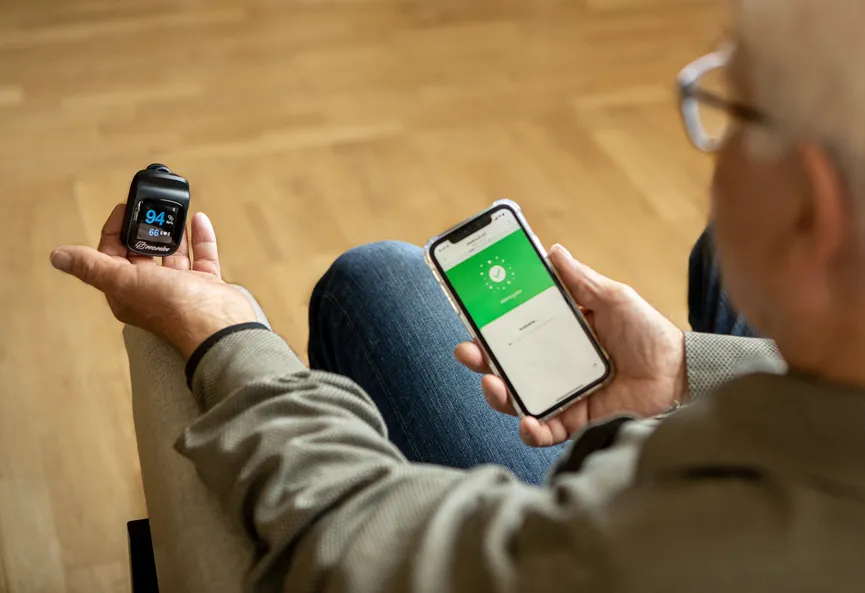

Through self-monitoring, we are able to detect and treat the majority of all exacerbations in time.